If you have ever spent a Saturday pulling weeds only to see fresh growth by the following weekend, you are not alone. Most gardens do not have a “weed problem” so much as a gap problem – bare soil, weak borders, soft edges and forgotten corners where weeds can get established faster than you can keep up.
Weed control for gardens works best when it is treated as routine maintenance, not a one-off blitz. The aim is simple: remove what is there, stop new weeds from taking hold, and keep the garden tidy enough that small jobs stay small.
What counts as a weed in a working garden?
A weed is any plant growing where you do not want it. That sounds obvious, but it matters because the best method depends on the type of weed and the area it is in.
In paving and gravel, the usual culprits are small annual weeds seeded by wind and birds. In borders and lawns, it is more often perennial weeds – plants with deeper roots that re-sprout when you leave even a small piece behind. Then you have self-seeders (like alchemilla, oxalis and various grasses) that are not difficult individually, but they multiply quickly if they are allowed to set seed.
The practical point is this: if you keep treating everything like a surface weed, you will keep getting the same results. Some weeds need pulling, some need digging, and some are best tackled by changing the conditions that let them thrive.
The three drivers of recurring weeds
Most weed outbreaks in Wiltshire gardens come down to a mix of timing, soil exposure and edges.
First is timing. If you only weed when it looks bad, you are often too late – annual weeds have already seeded, and perennials have stored energy in their roots.
Second is exposed soil. A freshly cleared border looks neat for about a week, then every seed in the neighbourhood sees a chance.
Third is the edge line. Where lawn meets border, gravel meets path, or fence lines meet open soil, weeds creep in. A clean edge is one of the most under-rated parts of weed control because it stops problems spreading sideways.
Start with an honest reset (without making a mess of the garden)
If the garden is already overrun, the best first step is not buying a stronger product – it is doing a proper reset.
For borders, work in sections so you do not end up with piles everywhere. Pull what pulls cleanly after rain, then dig out deeper-rooted weeds carefully with a hand fork or border spade. If you feel roots snapping, slow down and follow them. A quick tug is fine for shallow weeds; it is a waste of effort for bindweed and similar.
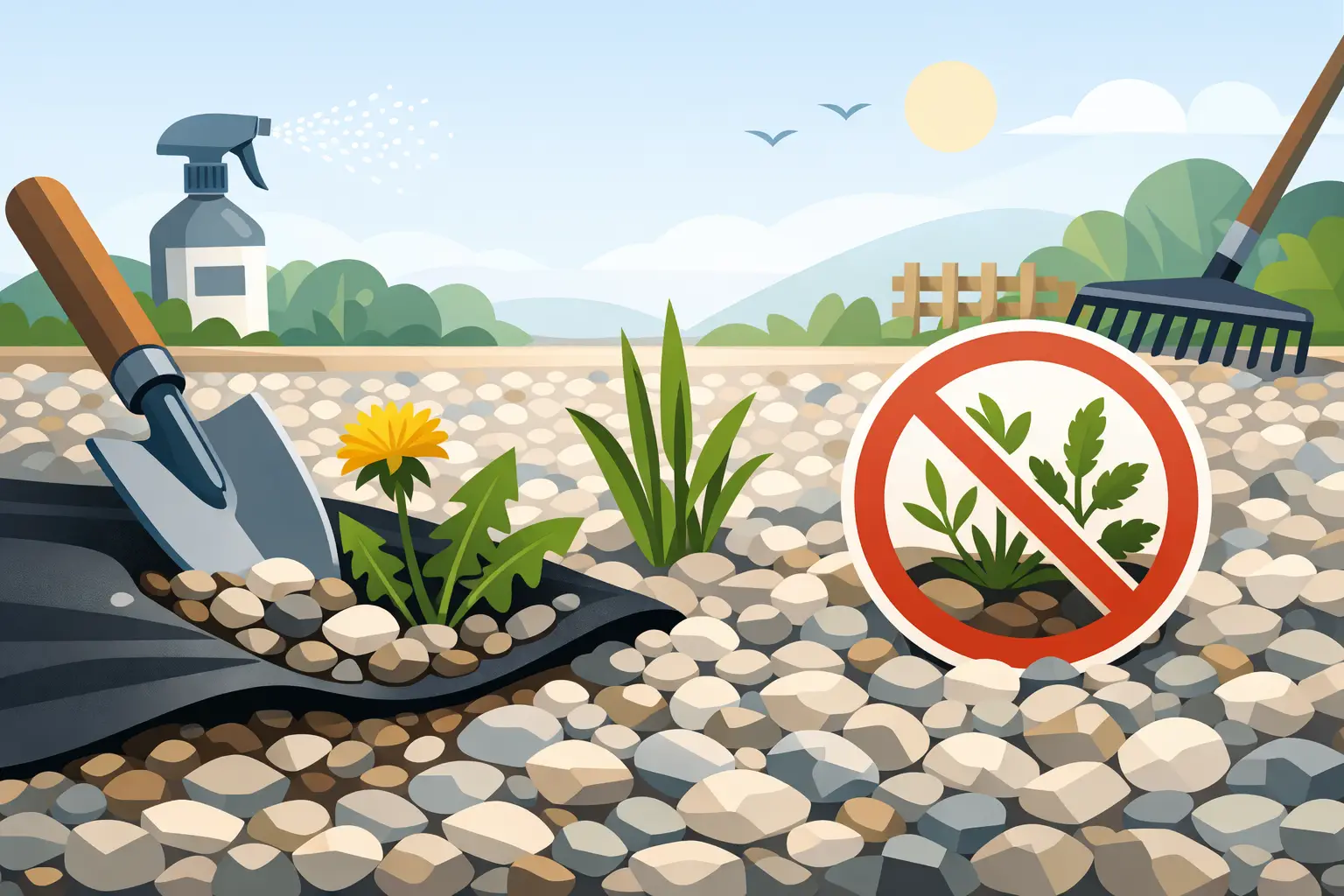
For gravel and paving, remove the top growth first, then brush out debris and old leaf matter. Weeds love the fine compost that builds up in joints and gravel. You can clear the surface and still have a perfect seed bed underneath unless you remove that build-up.
For lawns, avoid tearing at the turf in wet weather. If you lift chunks, you will create bare patches that invite more weeds. Broadleaf weeds can often be reduced with careful hand removal using a daisy grubber-style tool, but a thin lawn will keep letting weeds in until the grass is strengthened.
The trade-off with a reset is time. Done properly, it takes longer than a fast surface tidy. Done properly, it also buys you weeks and months rather than days.
Weed control for gardens in borders: the “cover the soil” rule
Once a border is cleared, the priority is to stop sunlight hitting bare soil. This is where most DIY weeding falls down – people do the hard part, then leave conditions perfect for the next wave.
Mulching is the most reliable, low-drama method. A 5-7 cm layer of well-rotted bark, composted green waste, or similar material blocks light and makes it harder for seeds to germinate. It also helps the border hold moisture, which means your plants cope better and fill space faster.
Mulch is not magic, though. Perennial weeds can still push through, and seeds can still settle on top. The difference is they are easier to remove, because the roots tend to be shallower in the mulch layer.
If you are starting from scratch or renovating an area, you can add a membrane under gravel or decorative stone, but it is not usually the best answer in planted borders. Membranes can restrict planting and tend to trap organic matter on top over time, which becomes another growing layer. In a working garden, organic mulches are usually easier to maintain.
Edging: the small job that makes everything easier
A crisp edge does two things. It makes the garden look maintained even before you have done the fine details, and it reduces weed creep.
In practical terms, edging means cutting back overhanging grass, redefining border lines, and removing the strip of mixed grass and soil that builds up at the boundary. If you keep edges tidy, you also reduce the amount of weed seed that gets flicked into borders when mowing.
If you manage properties or let a house, edging is one of the quickest ways to keep kerb appeal without needing constant heavy work. It is also a clear sign of regular upkeep – something visitors and tenants notice.
Paths, patios and driveways: don’t let joints become compost
Weeds in paving joints are rarely “just weeds”. They are a symptom of trapped debris.
Start by sweeping often, especially in autumn and after hedge cutting. Leaves break down into a fine layer that sits in joints and along the edges. Once that happens, even if you kill the top growth, new seedlings will appear.
If you use a pressure washer, be careful. It will remove weeds quickly, but it can also blast out jointing sand and leave gaps that fill with more debris. The short-term result looks great; the long-term result can be more weeds and loose slabs if you do it too aggressively. A gentler approach, followed by re-sanding or re-pointing where needed, tends to hold up better.
Gravel drives have a similar issue. Raking keeps the surface loose, but you will still need to remove the fine material that accumulates over time. If gravel has sunk into soil and turned into a mixed layer, weeds will always find it easier.
Lawns: build thicker grass and weeds back off
A thin lawn is an open invitation. If the grass is struggling, weed control becomes a repeating cycle.
The practical approach is to improve the lawn so it competes better. Mow regularly at a sensible height rather than scalping. Scarify if there is heavy thatch, aerate if the ground is compacted, and overseed bare areas so weeds do not claim the space first. Feeding in spring and early autumn helps, but only if mowing and watering are sensible.
It depends on the garden. Shady lawns under trees, for example, will always be more prone to moss and weeds unless light and airflow are improved. In those cases, accepting a less perfect lawn or converting tricky areas to beds can be the more realistic maintenance plan.
Seasonal timing in Wiltshire: when effort pays off
Weed control is easier when you work with the seasons.
Spring is when growth takes off. If you tackle weeds early, you prevent seeding and stop perennials from building strength. It is also the best time to refresh mulch once borders are tidied.
Summer is about staying on top of it. A quick, regular check stops small weeds becoming deep-rooted problems. In dry spells, weeds can be easier to pull from mulched beds, but tougher from baked soil.
Autumn is the make-or-break period for paths and borders. Leaf clearance is not just about looks – it stops that compost layer forming in paving joints and along fence lines.
Winter is good for structural work: cutting back, clearing overgrowth and getting access back to problem areas. You will still get some weeds in milder spells, but the main win is setting the garden up so spring does not start with a backlog.
Chemical and non-chemical options: choose the job, not the habit
Some clients want chemical-free gardens; others want the fastest practical fix for hard surfaces. Both are understandable. The key is using the right method for the right place.
Hand weeding, hoeing and mulching are reliable and tidy for planted borders, and they keep you in control around shrubs and perennials.
On hardstanding, targeted weedkillers can be effective when used carefully and in the right conditions, but they are not a substitute for cleaning out debris. If the joints are full of organic matter, the weeds will return.
Boiling water and heat treatments can work for small areas, but they are time-consuming and can be less effective on established perennials. They are also not risk-free around delicate planting.
If you are unsure, treat the first visit as a reset and then judge what keeps the garden in the best condition with the least ongoing disruption.
When it makes sense to bring in a maintenance team
There is a point where weed control becomes less about knowledge and more about time, equipment and disposal. If you are dealing with persistent weeds across multiple beds, long gravel drives, hedge lines that drop constant debris, or you simply want the place kept presentable without spending your weekends on it, regular maintenance is usually cheaper than repeated big clear-ups.
That is exactly the sort of routine work we do at Mossy Meadow across Wiltshire – one-off visits when a garden has got away, or scheduled maintenance to keep lawns, borders, edges and hardstanding consistently tidy, with green waste removal taken care of.
The most helpful mindset is this: aim for a garden that is easy to keep on top of. When the edges are defined, the borders are mulched, and the problem areas are checked little and often, weeds stop being a constant battle and become a quick, manageable part of keeping the place looking right.